
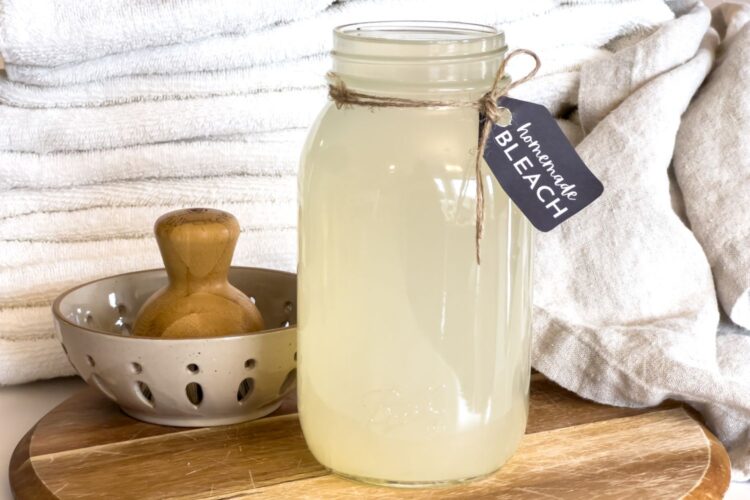
I get it. You have a tough cleaning project, and you feel like you have to use bleach to get the job done. But, you’re also trying to switch to a more non-toxic lifestyle, and you know that chlorine bleach is pretty bad for you! The great news is, you can get your tough cleaning jobs done without compromising your all-natural home. This homemade bleach alternative is beautifully effective, even without all of the scary side effects of chlorine bleach. And, it’s made with only 3 simple ingredients that you probably already have!
Why is chlorine bleach bad?
Chlorine bleach is unsafe for a variety of reasons, many of which are not commonly known!
Chlorine bleach can be fatal if swallowed.
This alone is enough reason for me to keep it out of my home. Especially with hoping that our family will be growing soon, it’s unimaginable to think of keeping something so poisonous in my home, especially in the name of “cleaning”. It’s amazing how cleaning ingredients can be amongst the dirtiest in our homes.
Chlorine bleach is corrosive, meaning it damages the skin, lungs, and eyes.
When bleach is being used, it can cause skin burns, burning in the lungs and throat, blurred vision, and more. It releases gases that are harmful, which is why you are never supposed to use bleach in a non-ventilated area. And yet, where’s the most common place that people use bleach? In the bathroom. Or the laundry room. Most of which do not have windows.
Chlorine bleach can give off toxic fumes when mixed with other cleaners.
When bleach is mixed with other common household cleaners, such as ammonia (another toxic household cleaner), it releases poisonous gases that are harmful and even fatal. It is never safe to mix these ingredients, and yet it could be an accidental mistake when all of these are available options in your cleaning cupboards. It’s another reason to keep ingredients like bleach out of your home!
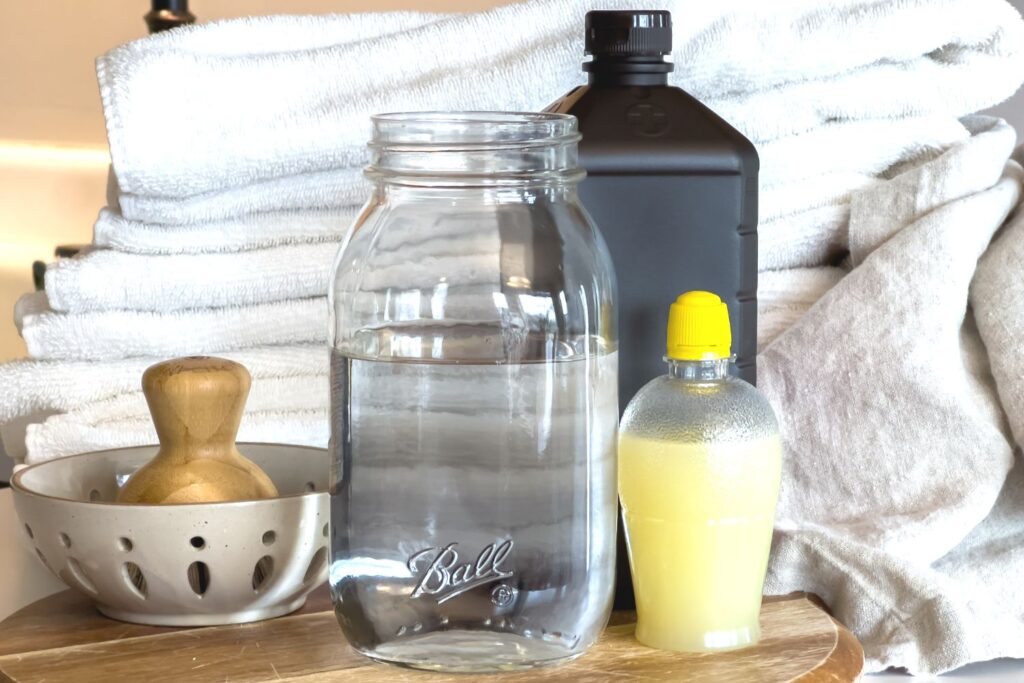
Homemade Bleach Alternative Recipe
Supplies
- Measuring cups: I use these measuring cups.
- Storage jar: Choose either a quart jar or a gallon jar. For long-term storage (or just because it’s beautiful), get an amber glass jar.
Ingredients
To Make One Quart (4 cups)
- 2 1/2 cups distilled water
- 1 1/4 cup hydrogen peroxide
- 1/4 cup lemon juice (store-bought or fresh-squeezed)
or
To Make One Gallon (4 quarts)
- 10 cups distilled water
- 5 cups hydrogen peroxide
- 1 cup lemon juice (store-bought or fresh-squeezed)
Directions
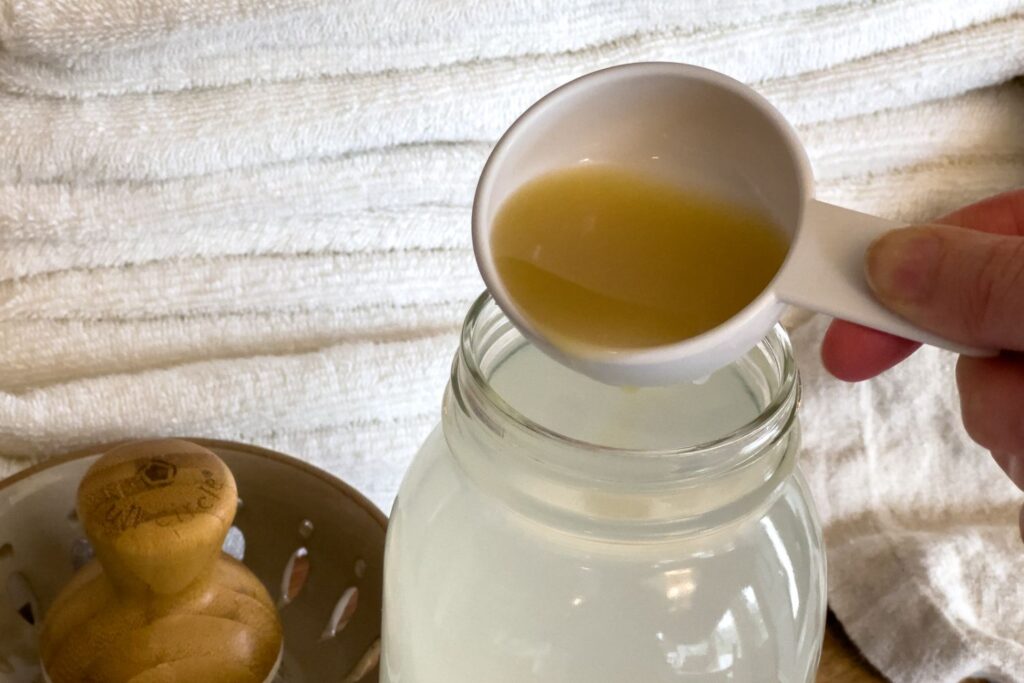
- Add all ingredients to the storage jar.
- Close the lid and swirl to combine. Make sure to label your jar!
- Store at room temperature in a dark place for a longer shelf life. For the longest shelf life, use an amber glass jar.
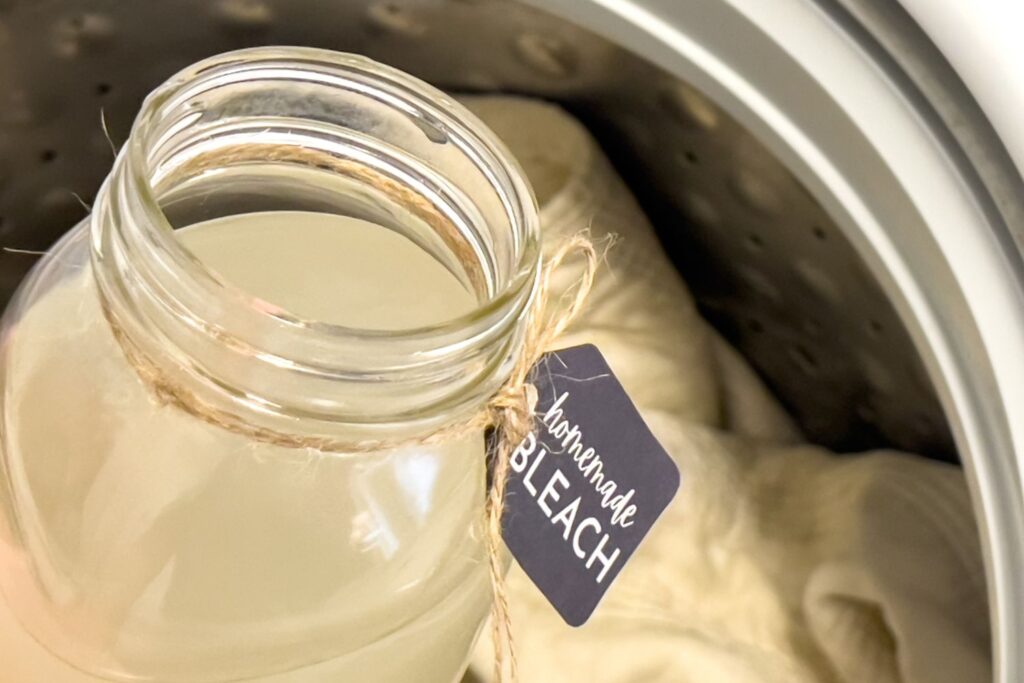
Tip for Making a Homemade Bleach Alternative Last Longer
This homemade bleach alternative will last for about 1 month in a clear jar, or about 3 months in an amber glass jar. This is because light exposure weakens the potency of hydrogen peroxide, and amber glass prevents light from entering the bottle.
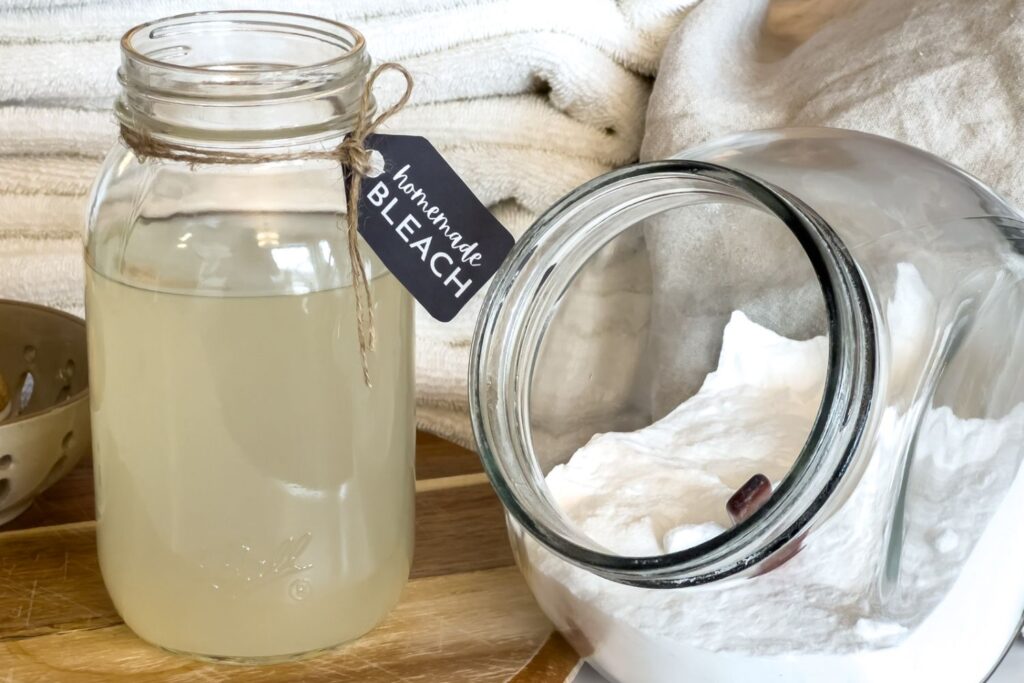
Ways to Use Homemade Bleach Alternative
For Laundry
- Towels & Linens: To whiten and brighten towels and linens, you can add 2 cups homemade bleach over the top of the clothes before running a cycle as normal.
- Extra Whitening Boost: For an extra powerful whitening boost, add 1/2 cup baking soda to the bottom of the drum, then add your laundry, then pour 2 cups of homemade bleach over the top of the laundry. Run the wash cycle with warm to hot water (depending on what the materials of the laundry can handle), with a soak setting on the wash cycle.
For Cleaning
- Farmhouse White Enameled Sink: Whiten your enameled sink by sprinkling baking soda across the bottom of the sink, and then drizzling homemade bleach over the top. Use a dish scrubber like this bamboo scrub brush to buff away stains and scuff marks. Rinse with hot water afterwards to reveal a sparkling and bright sink. Soak it overnight for extra tough stains.
- Tile & Grout: To make a powerful cleaning scrub for tile and grout, make a paste with homemade bleach and baking soda, and use a scrubber (like this cool battery powered scrubber) to buff away stains and grime.
- Countertop Stains: To clean stains out of countertops, simply soak a cloth or paper towel in the homemade bleach, and place over the top of the stains. Allow the homemade bleach to do its work, and then wipe it away!
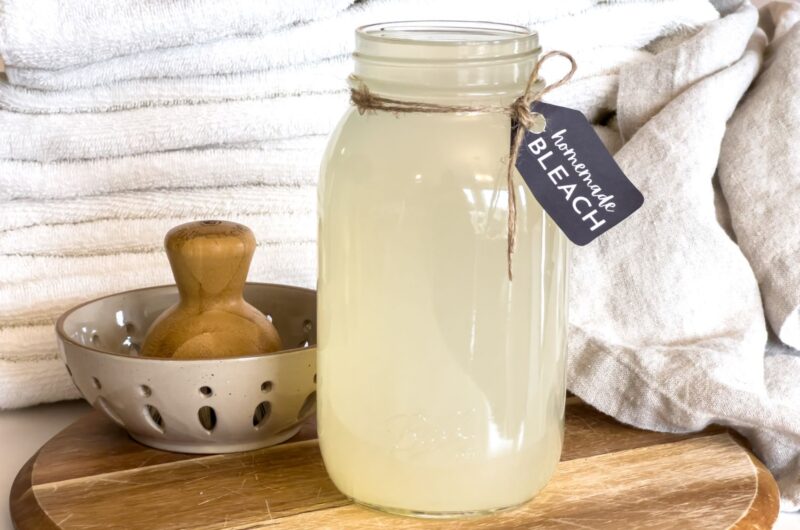
Bleach Alternative: Non-Toxic Homemade Bleach at Home
This homemade, non-toxic bleach alternative is perfect for laundry, for cleaning, and any other task that you would use bleach for. It’s so easy and only takes 3 ingredients to make!
5
minutesminKeeps your screen on while viewing recipe
Ingredients
- Supplies
– Measuring cups
– Either a quart jar, a gallon jar, or for long-term storage an amber glass jar- To Make One Quart (4 cups)
2 1/2 cups distilled water
1 1/4 cup 3% hydrogen peroxide
1/4 cup lemon juice (store-bought or fresh-squeezed)- To Make One Gallon (4 quarts)
10 cups distilled water
5 cups hydrogen peroxide
1 cup lemon juice (store-bought or fresh-squeezed)
Directions
- Add all ingredients to the storage jar.
- Close the lid and swirl to combine. Make sure to label your jar!
Recipe Notes
- Store at room temperature in a dark place for a longer shelf life.
- For the longest shelf life, use an amber glass jar to prevent light from breaking down the hydrogen peroxide. It will last for about 1 month in a clear jar, or about 3 months in an amber glass jar.
from my home to yours,





this is fantastic! I love using HP when cleaning.
Do I need to keep it in a dark jar? I’ve always heard the light breaks it down, and that’s why it’s in opaque dark containers in the store.
THanks!
Hi Tasha,
Thank you! You can keep it in a clear jar for short-term storage, or in a dark amber jar for long-term storage! The light will break it down over time, which can make it less potent if you aren’t going through it fast enough.
I hope this helps!
-Marlene
Can this be used on white shirts for brightening?
Hi Mary, thanks for the question!
Because this is an oxygen-based bleach alternative rather than a chlorine bleach, it is generally safe for use on color clothing! However, if it is a treasured piece of clothing, I always recommend to patch test it on an inconspicuous area just to be on the safe side.
I hope this helps!
-Marlene
This is the best alternative to using bleach. Bright clothes every time. I don’t use bleach any more.
Thanks, Lynette!
Does this stain clothes? I think this is a good alternative with children in the house.
Hi Susan, great question!
This is not known to stain clothes, I have never had it do that. In fact, it is really great at lifting stains and discoloration (on both white and color clothing)! If you’re worried about a specific piece of clothing, you can test on an inconspicuous area just to be on the safe side!
I hope this helps!
-Marlene
Hi, does this get rid of mildew?
Thanks.
Hi Marisa, great question!
This has the potential to get rid of some mildew if it soaks long enough. However, if you’re looking for something even more powerful to help with that, I recommend my Multi Purpose Cleaning Spray recipe. That recipe is also homemade with clean ingredients, but it is a powerhouse geared towards killing germs, mold, and mildew!
I hope this helps!
-Marlene
I found this on the internet.
Choosing the Right Container
When it comes to storing hydrogen peroxide, selecting the appropriate container is crucial to maintain its potency and stability. Here are some factors to consider when choosing the right container:
Material: opt for a container made of dark-colored materials such as brown glass or opaque plastic. This helps protect the hydrogen peroxide from light exposure, which can lead to degradation.
Seal ability: Ensure that the container has a tight and secure seal to prevent any leakage. This will also prevent the entry of contaminants that could compromise the quality of the hydrogen peroxide.
Chemical Compatibility: Select a container that is chemically compatible with hydrogen peroxide. Glass, HDPE (high-density polyethylene), and PET (polyethylene terephthalate) are suitable options.
Size: Consider the quantity of hydrogen peroxide you typically use. Choose a container size that allows for easy storage and dispensing without excess air space, which can contribute to the breakdown of the solution.
Remember, it is advisable to use a dedicated container for hydrogen peroxide and avoid repurposing containers that previously held different substances.
This information might help someone in considering storage of their bleach.
Hi Kathy,
Thanks for the input! This is all great info, I hope it helps people!
-Marlene
Is this safe to use on colors or just for whites?
Hi Gabby,
Yes, this is generally safe for color clothing! However, if you are worried about a specific piece, I recommend patch testing in an inconspicuous area just to be safe!
Thanks for asking!
-Marlene
Hi, I love this! Thanks for sharing. How well does it work? Like if I wanted to treat a stain or whiten laundry….?
Thanks
Hi Mel,
Thanks for asking! I personally find this to work really well! If the clothing is severely stained or discolored, it may take several soaking sessions to lift the stains. But I find it to work on most items!
I hope this helps!
-Marlene
I have a ton of lime juice that I’ll never be able to use. Would that be an okay substitution for the lemon juice?
Hi Abigail,
You can definitely substitute lime juice for the lemon juice.
Thanks for asking!
-Marlene
Can I use filtered water or does it have to be distilled?
Hey Tami, thanks for the question!
I recommend distilled water for longer term storage, but you can use filtered water in the short term!
I hope this helps!
-Marlene
Can you use this on color?
Hi Wendy, thanks for the question!
Because this is an oxygen-based bleach alternative rather than a chlorine bleach, it is generally safe for use on color clothing! However, if it is a treasured piece of clothing, I always recommend to patch test it on an inconspicuous area just to be on the safe side.
I hope this helps!
-Marlene
Why can’t we just put it in a rinsed Clorox bottle !
Hi Monica, great question!
The reason I would not recommend storing this in a leftover bleach bottle is because it is not safe for chlorine bleach to come into contact with cleaners that contain hydrogen peroxide. This can create a chemical reaction of heat and toxic gases. I personally would never risk there being remnants of chlorine bleach in a container that I was then trying to make my bleach alternative recipe in, since it does contain hydrogen peroxide. I strongly recommend using a separate container for this reason! 🙂
Additionally, the lemon juice in the recipe has the potential to break down the plastic over time, which is why I recommend a glass container especially for long-term storage.
I hope this helps! 🙂
-Marlene
Thank you for this recipe. Please specify whether it is 3% peroxide?
Hi Mandy! Yes, the hydrogen peroxide in the recipe is 3%. I have just updated the recipe card to reflect this information for others as well!
-Marlene
Why distilled water?
Great question! Distilled water helps to extend the shelf life because it is known to have lower bacteria counts compared to tap water. If you are going to use this recipe up quickly, then tap water would be just fine!
Can I put this in a dark glass spray bottle and use it to clean my showers in place of Clorox clean up? Will it affect my tile or grout in a negative way?
Hey there, Jenna! Yes you can absolutely store this in a dark glass spray bottle for extended shelf life. This would be a great alternative to Clorox for cleanup. It may take a few minutes longer to work compared to chlorine bleach, so I would spray it on generously and then let it sit for some time while you do other tasks. Then once it’s done bubbling, come back and scrub and rinse away! It should not affect grout or tile in a negative way, but it’s always recommended to do a patch test if you’re worried about it, just to be sure. Enjoy!
Hello! Could we do white vinegar instead of lemon juice? I like to keep lemon juice for food and drink lol.
Hey there, Skye! I’m sorry for the late response, I got behind on messages and am catching up. I wouldn’t recommend mixing vinegar with hydrogen peroxide in the same storage jar! If you would like to omit the lemon juice, I would replace it with equal amounts additional hydrogen peroxide.
For use, I would use it as a two-step system with the vinegar. So if you are planning to use this for laundry for example, you would use the hydrogen peroxide and water mixture with the clothes first, then run a rinse cycle, then use vinegar in a secondary soak! I hope this helps! 🙂
~Marlene
Hi Marlene, thanks for being there. I have some 35% Hydro and maybe it will really KICK these stains out of these older white wash clothes. Thanks for your recipe and time. Really needed this! I’ll let you know.
Hey there, Lynn! I’m so glad you found my recipe and that you want to try it for your laundry! ❤️ However, I wanted to warn you against using 35% hydrogen peroxide. This recipe specifically calls for standard 3% household hydrogen peroxide. The 35% solution is extremely concentrated and can cause serious skin and eye burns, so please don’t substitute it in this recipe!
If you’re hoping to get a more powerful clean on those older white washcloths, here are a couple of things you can try with the recipe as written!
1. Soak the clothes for longer. My washer has a one-hour soak setting, and I love using it for tougher stains! For some loads if they’re extra stained, I use 2 cups of the homemade bleach in the wash.
2. Try a second soak. If the stains are particularly stubborn, soak and rinse the clothes, then repeat the process with a fresh batch of the homemade bleach.
Keep in mind that older stains can be stubborn and may not come out completely in one treatment. I hope these tips help brighten up your washcloths!
Let me know how it goes! Thanks!
~Marlene